Web app · Live product
WeatherOS
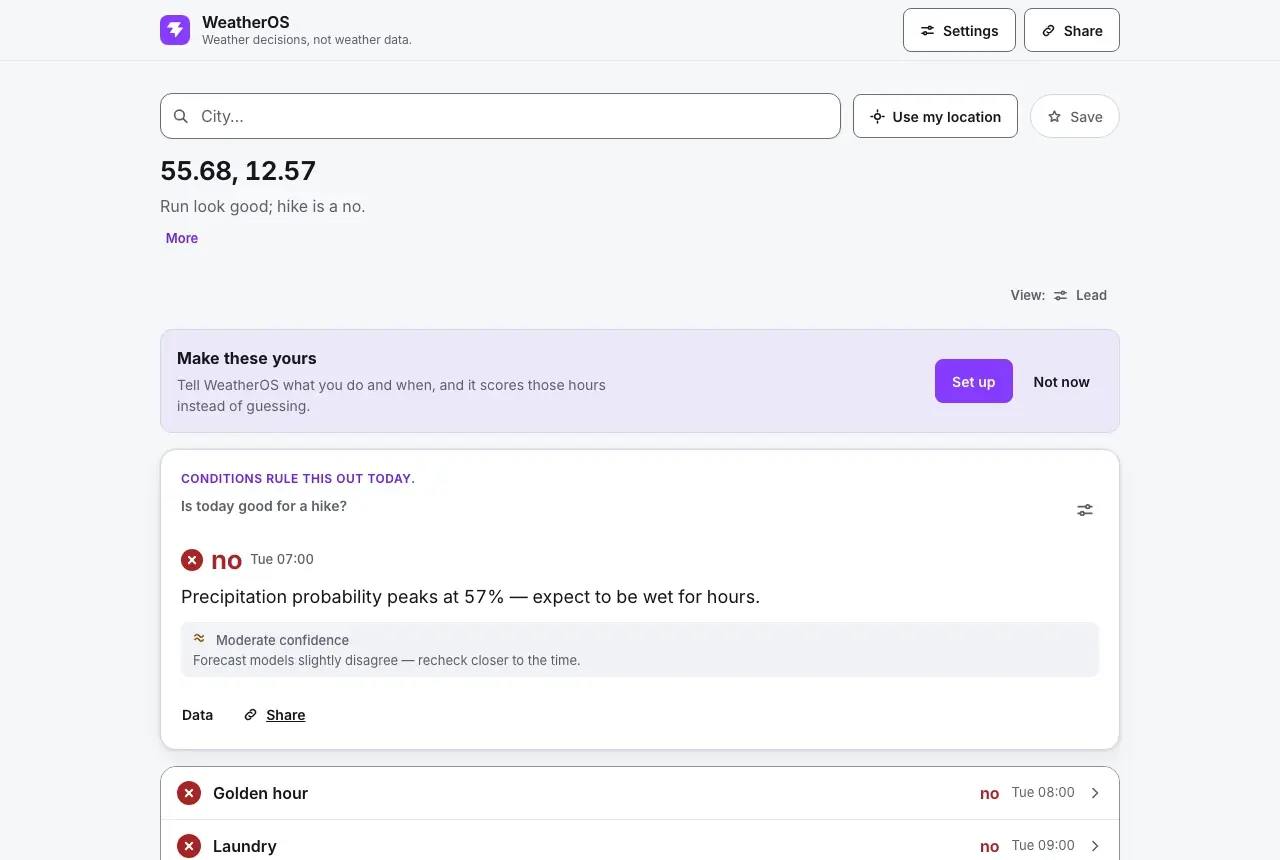
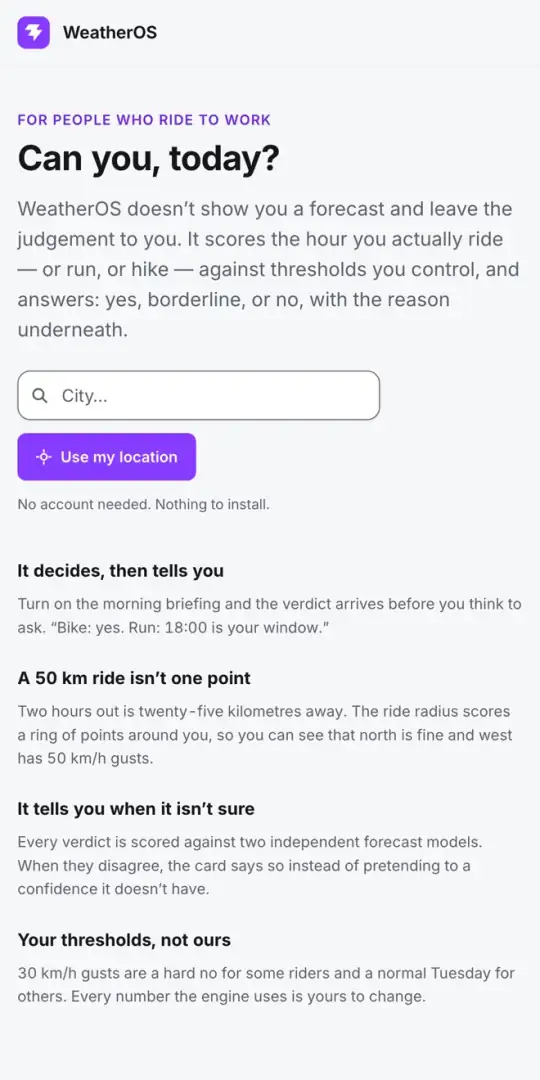
Weather as a decision. Ask “Can I bike to work at 8?” and get a verdict you can inspect.
- my part
- Design, frontend, backend
- platform
- Installable web app
- built with
- React, .NET 10, AWS
- status
- Live
The idea
A forecast gives you numbers and leaves the decision to you. I wanted the answer: “Can I bike to work at 8? Better not, gusts reach 48 km/h.”
4 of 8 decisions
- 0003
The AI narrates; the rules engine decides
Every verdict comes from a deterministic, unit-tested rules engine. Claude only puts the finished results into words, and a template does it when there's no API key.
what it costThe model is kept to the facts by its prompt, not by a schema, so it still has to be watched. - 0001
One shape for every kind of decision
Bike commute, running, hiking, laundry, stargazing and golden hour each implement one interface. A new domain is one class and one test file.
what it costEvery domain has to fit the same score. One that needs a richer answer means extending the shared result. - 0005
Web push without a library
Payload encryption and request signing are written on .NET's own crypto, following the two web push specifications.
what it costCompatibility bugs across Chrome, Firefox, Edge and Safari are mine to find and fix, and payloads over about 4 KB are rejected. - 0004
Sync without a password
An anonymous account comes first. A magic link attaches an email later, so nothing set up before is lost. Everything lives in one DynamoDB table.
what it costOne table answers only the questions its keys were designed for. Anything else needs a new index.
How I know it works
API and web suites run on 13 November 2026; browser tests counted from the suite.
What went wrong first
Settings started as one modal holding four unrelated jobs: notifications, the weekly schedule, sign-in and display. Onboarding was worse: it opened a form over six answers that had already loaded. Walking the app as a user made it obvious. Now settings is a real page, display choices sit in a popover beside the decisions they change, and onboarding is offered after the answers instead of before them.
Specs
- my part
- Product, design, frontend, backend, infrastructure
- platform
- Installable web app with a daily push briefing
- frontend
- React 19, TypeScript, TanStack Query
- backend
- .NET 10, Claude API, OpenTelemetry, AWS, DynamoDB
- forecasts
- Open-Meteo, with automatic fallback to MET Norway, cached for 10 minutes